

SAEC Cable Materials & Technology
For many years now, the Japanese company SAEC has been developing cutting−edge audio cables and holds a leading position in the Japanese market.
To achieve original sound reproduction, it is necessary not only to use materials of the highest quality but also to attain an optimal balance between various parameters, such as capacitance, impedance, resistance, and many others, as well as to correctly select and balance the materials from which the cable will be made.

The insulation material of the conductors is extremely important. In combination with the conductor material and its thickness, it has a different influence on the sound characteristics of the final cable. Many companies use a single insulation material for all types of their cables, believing that this will be the best solution for every cable. However, SAEC has thoroughly studied the influence of different types of conductor insulation on the sound of various cable types and now uses different insulation materials (Polyethylene, Polypropylene, or Semi−hard PVC) for different cables.
However, the conductor material remains the most important factor affecting the sound characteristics of a cable. SAEC has also excelled in this area. Close cooperation between SAEC and the Japanese manufacturer of the innovative PC−Triple C conductor enabled the company to obtain information and access to the new material at the development stage, which provided certain advantages and confirmed that the excellent characteristics of this conductor make it ideal for audio cables.
Almost all SAEC cables today are made from this superior PC−Triple C material, while the top STRATOSPHERE series uses the new, unique, and expensive PC−Triple C/EX material, which has a homogeneous two-layer structure consisting of a PC−Triple C copper conductor and 5N (99.999%) pure silver. In this structure, the PC−Triple C copper is pressed into a thick silver tube and then compressed by almost 70% through a forging process, which makes the crystalline structure of both the silver and the copper homogeneous and continuous in a single direction.
What is the PC−Triple C conductor? Pure Copper — Continuous Crystal Construction
This unique conductor was developed and first produced by the Japanese companies FCM Co., Ltd. (Fine Chemicals & Materials) and Hoso Bunka Tsushinsha Co., Ltd., in cooperation with Sekiguchi Machine Sales Co., Ltd. (Acoustic Revive). The method draws on ancient Japanese forging techniques used for crafting samurai katana blades.
The forging process consists of tens of thousands of sequential compressions of the copper, with strict control over the pressure, the angle of applied force, and direction. As a result of this complex forging process, the copper is densified by 70%, the transverse copper grains become oriented in one direction, and are elongated longitudinally. The distances between crystals are eliminated, all possible gaps and voids, inevitably present in cast metals, are removed, and the metal’s density becomes extremely high.
Initially, only virgin purified copper is used as raw material, and the resulting copper purity may seem unimpressive, since the FCM website states its percentage as 99.996% or higher. However, PC−Triple C copper has a completely different structure compared to even PC−OCC copper. Research has shown that in this case, electrical flow becomes smoother, stronger, and more stable. The material’s conductivity increases significantly. The forging process also substantially increases the conductor’s density by removing oxygen, which further improves the conductivity and sonic characteristics of PC−Triple C copper.
After the “Continuous Crystal Construction” process is completed, further processing using the Transfer Forging Method is applied, which produces finer wire gauges for subsequent use.
Immediately after the continuous forging process, the PC−Triple C conductor undergoes an annealing process. This process is carried out under strict control of temperature and annealing time, and depends on the thickness (gauge) of the conductor. As a result, the copper crystals fuse together even further, thereby forming a finished, homogeneous conductor structure.
PC−Triple C/EX — an Innovative Conductor for Audio Pure Copper — Continuous Crystal Construction / Extra
In 2018, one of the most advanced conductors in the history of the industry was announced in Japan, receiving the name PC−Triple C/EX (Continuous Crystal Construction / Extra). In the company’s press release, this new conductor is presented as “a new material created specifically for the audio industry, for high−resolution sound reproduction.”
The Japanese companies FCM Co., Ltd. and Promotion Works Co., Ltd., in partnership with other Japanese cable manufacturers, created a new two-layer conductor structure made of PC−Triple C copper and 5N (99.999%) pure silver by combining two ultra−pure materials into a single monolithic construction.
PC−Triple C/EX is an innovative product in which PC−Triple C copper is pressed into a thick 5N (99.999%) silver tube and then compressed by almost 70% using a forging process, which makes the crystalline structure of both the silver and the copper homogeneous and continuous in a single direction. The most remarkable feature of this conductor is its extremely high conductivity — 105.0% IACS — with a specific gravity of 9.5.
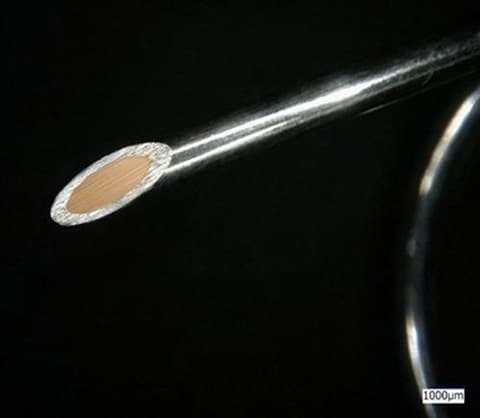
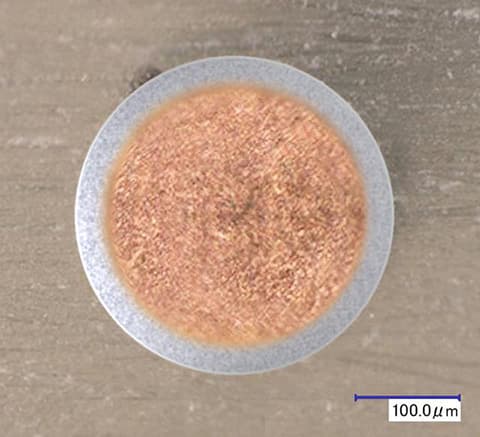
PC−Triple C/EX is not an ordinary traditional silver−plated copper conductor, which usually introduces undesirable colouration to the sound. This new conductor differs fundamentally from all silver−plated conductors in one key aspect. In a typical silver−plated conductor, the boundary between the silver and the copper is not homogeneous due to the mutual penetration of silver atoms into the copper layer and vice versa. As a result, the signal passing through the boundary area is alternately transferred between copper and silver atoms, making the current highly unstable.
PC−Triple C/EX limits transmission in the high−frequency range, reducing the skin effect exclusively within the silver part of the conductor. This combination with PC−Triple C copper at the center of the conductor allows for an extremely wide transmission bandwidth with the highest resolution.
The new PC−Triple C/EX conductor combines the maximum conductivity of silver — forming the geometry of the outer tube — with the maximum efficiency of ultra-pure copper of substantial cross-section, crystallised in the direction of signal flow, to transmit a wide range of frequencies.
Stratum & Superstratum Cable Structure Multilayer cable structures used by SAEC
Stratum and Superstratum are proprietary layered cable constructions developed by SAEC. Both designs use a conductor geometry based on the skin effect. This electromagnetic phenomenon causes current density to shift toward the surface of the conductor as signal frequency increases. By spatially separating the signal paths for low− and mid−frequency ranges from the high−frequency components, these structures achieve wideband signal transmission with improved resolution and reduced distortion. This conductor architecture is considered optimal for use in audio cables.
Stratum (two−layer structure)
This two−layer structure consists of a central, uninsulated solid−core conductor intended for transmission of mid− and low−frequency signals, and an outer layer in which concentrically twisted stranded conductors carry harmonic components and frequencies extending beyond the audible range.
This design is used, for example, in the SPC−850 speaker cable.
Superstratum (multilayer structure)
In this layered cable design, the central conductor intended for mid− and low−frequency signal transmission is electrically insulated from the outer layer of concentrically twisted conductors, which transmit harmonic components and frequencies above the audible range. The central conductor may be either solid−core or stranded, thereby implementing a Litz wire construction.
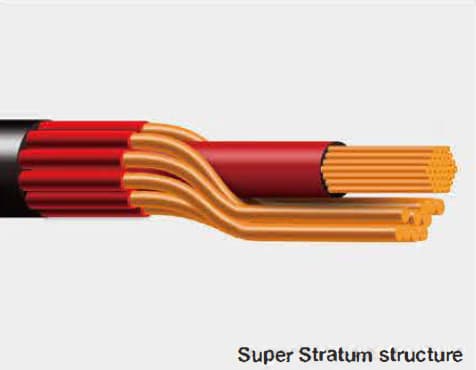
Cables utilizing this design include:
- Speaker cables: SP-1, SP-10
- Interconnect cables: SL-1EX, SL-1, XR-1
- Speaker jumpers: SJP-1, SJP-10